Kuaapy
Ayvu [Revista
Científico-Pedagógica], vol. 15 (núm. 15), pp. 107-141. INAES
Publicaciones.
eISSN 3078-4913. ISSN-L 224-7408. Licencia CC BY NC
SA 4.0
___________________________________________________________________________________________
Recibido el 29/2/2024 / Aceptado el 25/5/2024
Artículos
Analysing the classroom
environment: instrument creation, validation, and implementation
Análisis del entorno del aula: creación, validación y aplicación de instrumentos
Analisando o ambiente da sala de aula: criação,
validação e implementação de instrumentos
Marta Rovira-Mañé
Universitat Internacional de Catalunya: Barcelona, España
marta.rovira@uic.es
https://orcid.org/0009-0008-4755-5333
Jaume Camps Bansell
Universitat Internacional de Catalunya: Barcelona, España
jaumecamps@uic.cat
https://orcid.org/0000-0003-0930-1136
Abstract
This scientific paper
focuses on the creation of a new instrument to respond to the need to analyze
the quality of the classroom environment of today's classrooms, and
consequently, to be able to correct what is needed. Previous projects had some
shortcomings due to the year they were published, such as the emergence of new
technologies in the classroom, consequently a review and update seemed
necessary. Therefore, a new instrument has been created that adapts to the
current needs of students in the middle and upper cycle of primary school (8-12
years). All these characteristics that affect students have been assessed in
five variables: interest and motivation, satisfaction, relationship between
teacher and student, relationship among students and communication. After being
validated, the tool has been implemented in 46 classrooms of schools with
different characteristics and context. The results obtained have been analyzed
and statistically validated by IBM SPSS program through Cronbach's alpha, which
has ensured that there is consistency in each of the answers.
Keywords
Pedagogy; school; healthcare; learning environment;
school climate
Resumen
Este artículo científico se centra en la creación de un nuevo
instrumento para dar respuesta a la necesidad de analizar la calidad del
ambiente de las aulas actuales, y en consecuencia poder corregir lo oportuno.
Los proyectos existentes analizados presentan algunas carencias debido a su
antigüedad, por lo que nos pareció necesaria una revisión y actualización. Para
ello hemos creado un instrumento, que se adapta a las necesidades actuales de
los alumnos de ciclo medio y superior de primaria (8-12 años). Las influencias
del entorno que afectan a los estudiantes han sido clasificadas y evaluadas a
partir de cinco variables: interés y motivación, satisfacción, relación entre
profesor y alumno, relación entre alumnos y comunicación. La herramienta ha
sido implementada en 46 clases de escuelas con diferentes características y
contextos. Los resultados obtenidos han sido analizados y validados
estadísticamente con el programa IBM SPSS a través del alfa de Cronbach, lo que
ha asegurado que haya consistencia en cada una de las respuestas.
Palabras clave
Pedagogía;
escuela; cuidado de la salud; entornos de aprendizaje; clima escolar
Resumo
Este artigo científico
se concentra na criação de um novo instrumento para analisar a qualidade do
ambiente atual da sala de aula e poder corrigir quando necessário. Os projetos
existentes que analisamos têm algumas deficiências devido à sua antiguidade,
por isso consideramos necessário revisá-los e atualizá-los. Para isso, criamos
um instrumento adaptado às necessidades atuais dos alunos do ensino fundamental
II e superior (8 a 12 anos). As influências do ambiente que afetam os
estudantes foram classificadas e avaliadas com base em cinco variáveis:
interesse e motivação, satisfação, relação professor-aluno, relação entre
alunos e comunicação. A ferramenta foi aplicada em 46 salas de aula de escolas
com diferentes características e contextos. Os resultados foram analisados e
validados estatisticamente utilizando o programa IBM SPSS, por meio do alfa de Cronbach, garantindo a consistência das respostas.
Palavras-chave
Pedagogia; escola; saúde; ambiente de
aprendizagem; clima escolar
Introduction
The world is changing, and schools should keep pace
because they are educating the future members of society. Therefore, it is
essential to provide them with the skills they need to integrate into a society
that is new to them and constantly changing.
In addition, new technologies play an important role
in this process of change, because unlike years ago, students have access to
all the concepts they have learned in subjects such as history, languages,
natural sciences… with just one click. For this reason, some schools focus not
only on teaching content suggested by the curriculum, but also on training
people who are open-minded, self-confident, respectful, sustainable,
cooperative, freethinking, among others.
However, very few of them care about analysing the context in the classroom. Are students
satisfied with their lessons? Is there disrespect among peers? Are students
afraid to intervene in class to express their opinions or ask questions? Do
students trust the teacher to express how they feel? Is the social environment
of the classroom promoting the learning process?
All these questions are difficult to assess through an
observational method, as not all the situations are visible to everyone and
there are things that slip from our grasp. For this reason, teachers and
schools should be provided with a tool that gives students a voice, so that
educators can get feedback on the quality of the environment, correct what is
necessary and create spaces conductive to learning and safety.
In 1970, there were many experts who became interested
in the topic of the social climate in the classroom and formulated a definition
(Brandt & Weinert, 1981). It has been found that the classroom environment
is one of the school variables that best predicts learning (Maldonado, 2016;
UNESCO, 2014).
By 2009, experts such as Pérez, Ramos and López (2009)
and González, Touron and Tejedor (2012) created and
validated the instrument due to an increasing demand from teachers. However,
due to the publication year of the study, it does not consider the current
characteristics that surround second and third cycle students in the classroom.
In addition, it is not accessible to all teachers because of the difficulty in
interpreting the results.
It is difficult to define the classroom environment,
because it is a concept that encompasses many dimensions grouped into two main
levels: the material part, including infrastructure and furniture; and the
immaterial which includes people and the interactions between them in the
classroom atmosphere (Arón & Milicic, 2004).
Therefore, the most accurate definition is «the perception that each member of
the classroom has about their internal and daily life. This perception promotes
individual and collective behaviour (a way of
relating to each other and with the teacher, a way of being ...) that at the
same time influences the environment itself» (Pérez, Ramos & López, 2009,
p.223). As can be seen in the definition, the student, the teacher, and the
curriculum are the three of the elements that make up the classroom atmosphere
and the balance between them positively affects the environment as well as the
teaching and learning process (Vaello, 2011). It
should be noted that within these three major groups, several factors
surrounding the students in the classroom environment must be considered. For
example, interest and motivation, relationships between students and them with
the teacher, communication, physical space, among others. (Barreda, 2012;
Moreno et al., 2011; Villanueva, 2016; Rojas, 2013)
Firstly, it is important to consider that there is a
low level of motivation among students, which has a negative impact on social
satisfaction, interpersonal relationships, social coexistence among others
(Manzano y Valero-Valenzuela, 2019). According to Manzano-Sánchez (2021), this
demotivation begins in the last years of primary school, increasing the
possibility of school failure and continues in secondary school. For this
reason, Manzano-Sanchez (2021) says that interventions are needed to improve motivation
and thus strengthen a good classroom atmosphere.
Secondly, when creating a good environment, the
teacher must also be motivated and interested in the students. In this way,
they will not only show certain competencies, skills, and mastery of the
content, but will also implement a motivating and varied methodology, a
pleasant distribution of space and establish a respectful interaction by having
a “pedagogical touch” (Baños et al., 2017; Biggs,
2005; Perrenoud, 2005; Arón y Milicic, 1999).
Artavia, (2005), defines the concept of pedagogical touch as the ability to
know how to interpret thoughts, feelings, and inner desires through facial
expression and body language. For this reason, the relationship between teacher
and student may be affected by the methodology applied, the distribution of
space, among others (Barreda, 2012).
Following this line, it should be noted that there are
some teaching styles that positively or negatively affect the existent
relationships in the classroom (González, Conde, Díaz, García, & Ricoy,
2018). An authoritarian teacher is the one who pressures all students to do
their homework following their perfectly established model, even if it is not
the most suitable for their level. If the student decides to do the task using
the established method, the teacher is pleasant, on the contrary, the professor
shows a bad mood since the student does not obey (Marchesi & Hernández,
2000, as cited in Figueroa, 2012). In this way, a distance is created between
the teacher and the student, making students afraid to ask questions or
communicate social or emotional problems to the teacher. Therefore, according
to Goleman (1999), the authoritarian leadership style has a negative impact on
the classroom environment.
On the other hand, there is the democratic style,
which “encourages group members to determine their goals and make decisions,
striving for everyone to participate. Responsibility is shared with all members
of the group” (Cuadrado Reyes, 2009, p.3).
In addition, the teacher is empathetic, both inside
and outside the classroom, caring about emotional and social issues; allows
students to express their concerns and doubts that may arise; adapts the
methodologies to the individual needs of each student and with the aim of
achieving the common good, establishes equal rules for the whole class
(Madrigal, 2004). In this way, a relationship of trust and empathy is
developed, and as a result, according to Goleman (1999), the democratic
leadership style has a positive impact on the classroom environment.
Following the idea mentioned above, the teaching style
not only affects the relationship between teacher and student, but also the
student’s participation, level of attention and understanding of the lesson. If
there is a relationship of trust and empathy between teacher and student,
communication between the two will be more positive, open, and constructive
(Vieira, 2007). Although communication style may be affected by gender,
culture, and other individual characteristics (Camargo Uribe & Hederich Martínez, 2007).
In addition, it is very important to consider the
interaction between teachers, because during the internships in the schools it
was observed that communication between teachers positively affects the
students and therefore the atmosphere of the classroom. For example, teachers
from a school in the Vallès Occidental
region, meet every week to distribute the weekly homework in a more equitable
way. This has had a positive effect as students have time to complete their
homework without any anxiety due to the amount of work that has
to be done outside school.
Finally, it is important to establish good
communication between the school and the family, because if there is no good
communication, the family context can become a problem and consequently have a
negative effect on students (Estévez et al., 2005). Parental involvement in
school is very important, having a positive effect on students and on parents
who are more satisfied with the teachers and the school. In addition, teachers
are more involved in activities, have more competence in their profession and
have more empathy with students and families. As a result, the student has a
positive attitude towards authority and a positive perception of the school,
which promotes integration and improves academic performance. (Moreno et al.,
2009).
In the last century, the classroom was already
considered an artificial space where students are placed next to each other
without prior ties, day after day, with structures of communication and
authority (Quintana, 1980). This grouping of students
without a free decision to join makes it a handicap because it can negatively
affect the emotional perception of relationships between students (Biscarri, 2000).
This is one of the reasons why problematic situations,
misunderstandings and disputes arise in the classroom, which can be visible to
the eyes of the teachers so they generally act as mediators (Munne, 2015), or
hidden from them, which may develop into school bullying. Bullying is not a new
problem but has been present in schools since the 19th century and has been
evolving to the present day. (López & Sabater, 2019). The victim suffers
physical and psychological aggression, exclusion, their material is not
respected among others. As a result, there are symptoms of stress, depression,
and nervousness to participate in class leading to school failure. (Oñate &
Piñuel, 2007)
As can be seen, the relationship between students is
an issue that directly affects the classroom environment and therefore all the
aspects mentioned above must be considered to evaluate it. Some factors that
influence student satisfaction in the classroom, such as new technologies,
class distribution, order and noise during theoretical explanations, and
teacher competence.
On the one hand, according to Gámiz
(2009), Dugarte y Guanipa (2009) y Marqués (2010)
the digital world demands changes in education and teachers are responsible for
applying information and communication technologies in their educational action
to achieve a more student-centered and personalized paradigm. Information and
communication technologies bring many advantages and improve the quality of
teaching (Almenara, 2007), but they are not yet widely used in class due to the
low training of primary school teachers (Martín, 2009).
On the other hand, the distribution, order, noise, and
equipment of the physical classroom also have a positive or negative effect on
the students who make it up (Gairín, 1995). For
example, it is essential to allocate a space in the classroom to display the
work done by students in the classroom, as it encourages and motivates them and
at the same time makes the class a more personal and warm space which
positively affects the classroom environment (Cela & Palou, 1997).
The general objectives
of the paper are:
A. Create and validate a new instrument to assess the
classroom environment, so that it adapts to the new characteristics that
surround the students from the second and third cycle in the current
classrooms.
B. Analyse samples from different classrooms to present in a practical way how the
instrument works.
C. Validate and verify the effectiveness of the
instrument in schools with different contexts, such as private, semi-private,
public, urban, and rural schools in Catalonia and one in Helsinki, Finland.
Methods
Creation of the instrument
The instrument was created by the researcher of this
paper but was mainly inspired by the journal article of Perez, Ramos &
Lopez (2009), which is a previous tool that assesses the classroom environment.
However, this tool developed in 2009 has some shortcomings due to the year it
was published, such as the emergence of new technologies in the classroom.
Therefore, the instrument created in this paper considers three other articles.
The first one is a journal article by González, Touron and Tejedor (2012) from which some ideas of
questions related to the physical classroom were extracted. Second, this tool
was also inspired by the journal article from Vásquez, Zuluaga and Fernández
(2012) in which there is a tool to detect bullying and cyberbullying. Finally,
to assess the impact of technologies on the classroom environment, the article
by Mousavi, Mohammadi, Mojtahedzadeh, Shirazi and
Rashidi (2020) was considered.
After analysing the above
articles, two questionnaires of 37 questions each were created as a final
product, one for the middle cycle (8-10 years old) and the other for the upper
cycle (10-12 years old) (Appendix 1).
These two questionnaires differ only in question
number 36, which in the upper cycle deals with cyberbullying, while in the
middle cycle it focuses on bullying. It was decided to change this question in
the middle cycle, since in the interview prior to the administration of the
questionnaire, some teachers commented that middle school students do not
communicate via the Internet because they do not have a cell phone or other
devices.
The questionnaire was designed to measure the
following variables: interest and motivation, satisfaction, teacher-student
relationship, peers’ relationship, and communication; considering new
technologies, student fear, bullying, among others, all the characteristics
that currently surround students and affect the atmosphere (Appendix 2).
It should be noted that some accommodation has been
made to help all students with different learning diversities, disorders, and
languages, and consequently ensuring that everyone understands what is being
asked. For example, the audio of the questionnaire (Rovira-Mañé,
2022) was made to facilitate comprehension, and it was printed in large size to
accommodate students with dyslexia and other disorders. Moreover, the survey
was translated into Catalan, English, Finnish, Russian, Korean, among others, in order to attend to all those newcomer students who do not
yet speak the official language of the school. Finally, teachers were able to
choose whether to complete the questionnaire online through the Google Forms
application or with printed paper depending on the general characteristics and
needs of the students in the class.
Validation of the instrument
To create a rigorous instrument, first before
implementing the questionnaire a qualitative validation of the questions was
done, asking for the opinion of different experts.
Secondly, after the application of the questionnaires
in different classrooms, a statistical validation of the results obtained was
made, both answers obtained in the whole class by means of the variables
Cronbach’s alpha statistics, and individually through repeated questions
formulated differently.
After the validations, if the answers were consistent,
the final report of the environment of each classroom
was elaborated, taking into account the 5 dimensions analysed. The validations carried out are explained in
detail below.
On the one hand, before the implementation of the
questionnaire in the classroom, the questions of this tool were validated by
education professionals and by members of the Fundació
de Moviments de Renovació Pedagògica de Catalunya (FMRPC), which is a Catalan entity
created in 1981 with the aim of having a quality Catalan public school. It
should be noted that appropriate corrections were made based on this expert
validation (Appendix 2). These experts have considered the validity of the
content where it is verified that the questions include all aspects of the
different variables studied and the validity of construct to know if the
questions represent all the characteristics that affect the classroom
environment. In addition, they also analysed the
criterion validity, that is, whether the questions of each variable are
related and meaningful.
On the other hand, after the implementation the
answers obtained in each of the classes were validated from a statistical point
of view through the IBM SPSS program.
Firstly, the value of the Cronbach’s alpha is checked,
which indicates the consistency and homogeneity of the data, so it is necessary
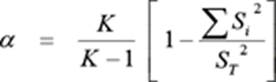
to validate the answers before making any interpretation. To calculate it, the
program uses the following formula, where Si² is the variance of the answers to
a question, St² is the variance of the total values observed, and k is the
number of questions.
Figure 1
According to a group of workers from the American
Psychological Association (Wilkinson & APA Task Force on Statistical
Inference, 1999), Cronbach's alpha is the most widely used coefficient in the
social sciences and health articles. This idea is supported by a study stating
that 75% of publications are based on Cronbach’s alpha. (Hogan et al., as cited
in Frías, 2021)
Therefore, to evaluate and represent the reliability
of the answers, Cronbach's alpha gives a value from 0 to 1 for each question in
the tool, where the closer to 1 the greater the consistency of the responses analysed within a class. In other words, if the answers
provided by students of the same class were identical, they would be perfectly
correlated and therefore the result would be equal to 1. Otherwise, if there is
no relationship among the answers of the participants the value of alpha would
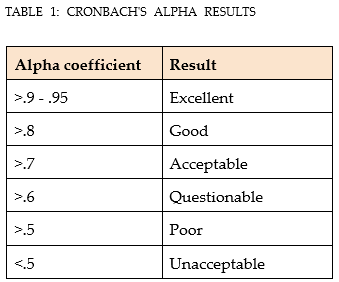
be equal to 0. To determine the consistency of the data, George and Mallery
(2003, p.231) recommend using the following table to evaluate the results
according to Cronbach’s alpha coefficient.
For this reason, in this project, it was determined
that the Cronbach's alpha variable must be above 70% (> = 0.7) to be
considered a reliable questionnaire.
If the analysis of the answers shows a result of the
Cronbach’s variable below 60%, the evaluation is done by eliminating any of the
questions that may have affected the lack of coherence, which could be a
misunderstanding of the question. At this point, this answer would be removed,
and the analysis would be continued, but if after deleting any of the
questions, we still have the variable result below 60%, then it would be
unreasonable to continue the study of that class.
In addition, extra control was added in this study,
foreign to Cronbach's alpha. It consists in adding to the questionnaire
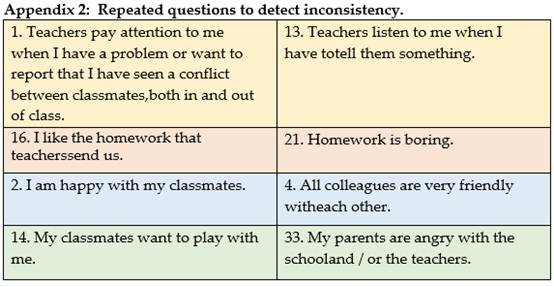
repeated questions but formulated differently (Appendix 3), to be able to
detect and exclude any student who has answered the questions randomly and that
therefore has contradictory answers. To detect them, the correlation value was
checked between those repeated questions, if it comes out above, 700 individual
questionnaires will be analysed to see if there are
any students who have contradicted in more than one repeated question. If so,
the answers from that survey are removed and the class information will be
re-processed in the program. Conversely, if it is observed that a student only
contradicts one of the repeated questions, the questionnaire will be considered
because it may have been a misunderstanding. The correlation means similarity,
so if you get 1 it means that the results of the two questions are the same,
while with a 0 they don't look alike. In summary, this study also tries to
contrast and ensure that there are no contradictions between the answers of the same individual questionnaire. In this way,
inconsistencies can be detected, and the participant can be excluded.
Once it has been ensured that all the data entered in
the program for each questionnaire is valid, the information is analysed in detail in a global way considering the variance
of the different questions, that is, the dispersion of questions regarding the
average. If the variance is equal to 0, it means that all the students have
answered the question in the same way; on the contrary, if it increases, it
indicates that more students think differently. Nevertheless, a detailed
analysis of the answers will only be done if the value is high, as it may
reveal that there are responses contrary to the mean value, which, in some key
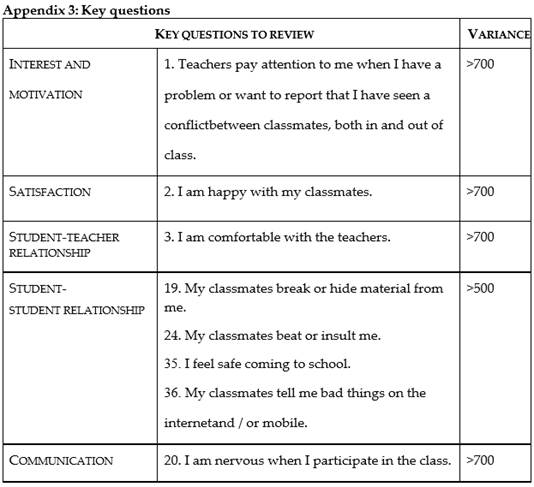
questions (Appendix 4), may be relevant but not detected in the mean values of
the global class. However, a high value in other questions such as “The class
is tidy, so I'm comfortable”, may simply indicate that a class may have
different criteria for a topic.
Once the two checks have been made, both for the
individual and group responses, the data is used to obtain and evaluate the
classroom atmosphere. To obtain a value that represents the environment, each
question has four answers: always, usually, sometimes, and never where the most
positive is given 4 points and the most negative 0. The sum of all the
individual scores of each of the answers allows the researcher to obtain the
total value of the class to form a scale. In addition, the questions are grouped
into 5 variables; this will allow the researcher to see which are the
weaknesses in each of the classes analysed and
therefore should be improved. This process is repeated for each of the
classrooms, as it may be reliable for one sample of students but not reliable
for another.
Piloting the instrument
To conduct the investigation, principals and primary
school coordinators of the different schools were contacted via e-mail. These
professionals arranged a pre-face-to-face meeting with the researcher at the
school, so that they could check the questionnaire and talk about the day,
time, and courses where the implementation would take place. In this meeting, it was also discussed in which courses the
questionnaire would be administered through Google Forms using the
schools’ devices and in which courses the printed questionnaire would be used.
On the day the study was conducted at the school, the
researcher went from class to class explaining the instructions of the
questionnaire and solving questions to children who needed it, while the class
teacher, who had received instructions in advance, directed the application of
the questionnaire. It should be noted that the questionnaire was administered
in Catalan or English, depending on the school’s official language, but as
mentioned in the «creation of the instrument» section, if a student did not yet
speak the official language of the school, the child was allowed to complete
the questionnaire in his or her mother
tongue to ensure that all students understood what was being asked. In terms of
time, the students took an average of 15-20 minutes to complete all the
questions.
Participants
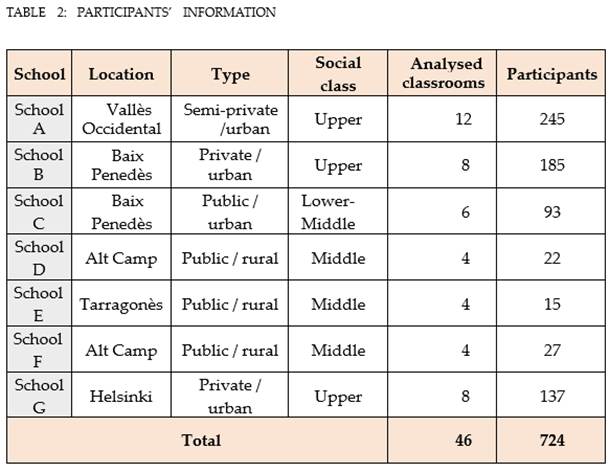
The study was carried out in 24 middle
cycle classrooms (8-10 years old) and 22 of the upper cycle (10-12 years old)
coming from private, semi-private, public, urban, and rural schools from
different areas of Catalonia, as shown in the table below. In addition, the
instrument has also been applied to a semi-private school in Helsinki to
evaluate the effectiveness of the tool in other contexts. All students in these
schools will have to answer all the questions individually, avoiding
interaction between classmates to ensure that everyone answers what they think
without being influenced. As can be seen in the table below, the names of the
schools have been replaced by the letters A to G in order to
maintain the anonymity of the schools participating in the study.
Results
The main result of this research is the questionnaire
explained in the «Methods» section. Therefore, this part will show the
validation results and examples on how to apply and analyse
the instrument information, to present in a practical way how the instrument
works.
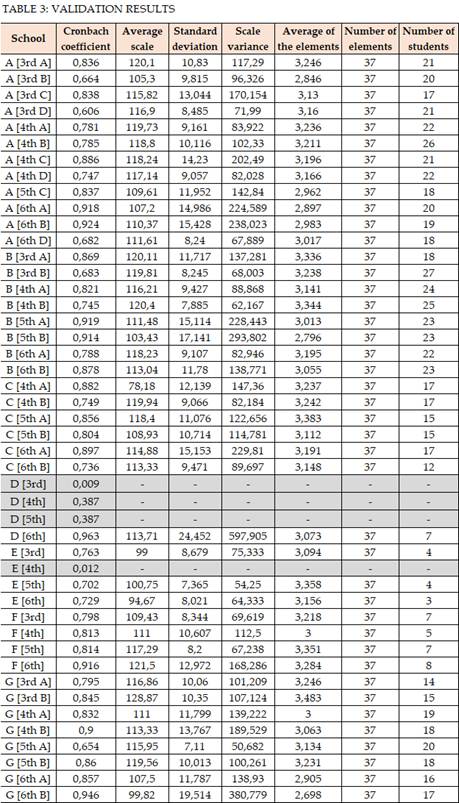
Before interpreting the validation
results, it is worth considering that the consistency and reliability of the
data had to be analysed through four checks. Firstly,
if the students answered all the questions, secondly, the correlation of the
repeated questions, which should be around 1, then the correlation of the
similar and opposite questions, and finally the Cronbach's alpha. The facts in
a sample are considered very reliable if the Cronbach alpha is above 0.7 and
unreliable if it is below 0.5. Therefore, all the classes that did not exceed
this value, and consequently are not considered reliable, have been marked in
red and the next step, which is to interpret the data, was not carried out.
Once the researcher was sure the
information is reliable, the interpretation of the data is carried out (table
3), where the following values are analysed: the
arithmetic mean of all the questions, the standard deviation and the variance,
which indicate how much the answers vary with respect to the mean, the value of
the key questions where low values should appear and, finally, the number of
students, since one student in a class of 25 students is equivalent to 4% while
one student in a class of 4 students represents 25% of the class. As the table
shows, the values obtained in 42 out of 46 classrooms are consistent, so the
tool is validated.
Before starting with the analysis of the results, it
is necessary to check the reliability of the data, as mentioned in the
«validation of the instrument» section. Once it has been verified that all the
data provides information, the researcher proceeds to represent the average
values of the class classified in the 5 variables through a graph to facilitate
understanding. Some samples from different schools have been analysed to show in a practical way how the tool works.
Discussion
The result of the study, which is the creation of a
new tool for assessing the climate in the classroom, shows that the first
objective has been achieved. The results of several authors who had already
studied and created previous questionnaires but with different objectives in
mind, were considered to implement this instrument. Therefore, these results
will be discussed in the light of the literature review below.
As stated by Perez, Ramos & Lopez (2009) in the
journal article, the following variables are essential to evaluate the
classroom environment: interest, satisfaction, relationship, and communication.
For this reason, the same dimensions have been included in this study, but
separating the questions related to teacher-student relationships and
student-student relationships. These two variables must be evaluated separately
because they reveal different information. One may be well appreciated by the
students, while the other may not, and to improve each of them different
measures should be applied. In terms of the questions, this study has also been
inspired by those of Perez, Ramos & Lopez (2009), but as mentioned in
previous sections, due to the year of research it does not cover all the
characteristics that surround the current classrooms such as new technologies
and disadvantages of this area, for example, cyberbullying. It also does not
include other key aspects such as physical education or bullying, so the
following authors have also been considered in the creation of the new tool.
As stated in the journal article by González, Touron and Tejedor (2012), when assessing the classroom
environment, one must also consider how students feel about the distribution of
the class, orderliness, and noise. For this reason, questions related to this
area have been included in the results of this new tool which has enriched the
results of this study.
Moreover, in the final product of this study,
questions have been added to detect bullying, since the study by Vásquez,
Zuluaga and Fernández (2012) ensures that bullying is a social reality which is
present in many of the classrooms affecting peer relationships.
Finally, the last instrument includes questions about
new technologies that affect students in almost all variables, which is why the
article by Mousavi, Mohammadi, Mojtahedzadeh, Shirazi
and Rashidi (2020) has been considered.
The tool for evaluating the classroom environment is a
questionnaire that translates the answers; always, sometimes, several times and
never into numbers; 1, 2, 3, 4, to be able to process them through a program
that draws statistics from the data obtained. The questionnaire gathers 37
questions to evaluate 5 variables; interest and motivation, satisfaction,
teacher-student relationship, peers’ relationship, and communication;
considering new technologies, student fear, bullying…
Before being analysed, a
series of checks are carried out to ensure that all the data are reliable and
finally the average of each variable is plotted on a graph. This tool has been
validated through the evaluation of 6 Catalan schools with different
characteristics and one in Helsinki to check the effectiveness of the
instrument in different contexts.
Returning to the objectives established in the
introduction, each of them has been fulfilled in this article. As objective A
“create and validate a new instrument to assess the classroom atmosphere so
that it adapts to the new characteristics that surround the students of the
second and third cycle in the current classrooms” indicates, in this study, a
tool that assesses classroom environment has been created and statistics were
run to validate it. This program has allowed the researcher to know that all the
results obtained and analysed in this academic paper
are coherent and, as a result, announces that no question should be discarded
from the tool. It should be noted that the data from four rural school
classrooms were not interpreted due to the low Cronbach's alpha value obtained.
In addition, considering objective B “analyse samples from a school to present in a practical way
how the instrument works”, six samples from different schools have been analysed, the results of each class have been represented
through a graph to make it easier to understand. In each class, the results of
each of the variables obtained are higher than the minimum acceptable,
therefore, it could be said that all the samples evaluated can have a good
classroom environment.
Finally, as the last objective indicates «validate and
check the effectiveness of the instrument in schools with different contexts,
such as private, semi-private, public and rural schools in Catalonia and one
Finnish school», to validate the instrument, 46 samples of schools with
different characteristics and contexts were analysed.
In this way, this study has represented a real sample of all the varieties of
schools in society, segregated by gender, mixed, private, semi-private, public,
rural, and international. For this reason, it could be said that diverse and
significant data were obtained for statistical validation.
In conclusion, it could be stated that the instrument
works well because it has identified the different strengths and weaknesses of
each classroom. It should be noted that a more detailed analysis of the less
valued variables allows us to know which of the questions lowers the average,
and as a result, the teacher could apply corrective measures to continuously
improve all the variables. To see the evolution, this tool should be
implemented from time to time to ensure that there is a good environment in a classroom.
It is noteworthy that this article has gone beyond the objectives set out in
the introduction because, as observed in the analysis of the four schools, the
high values of variance of the key questions (Appendix 4) could detect cases of
discomfort, insecurity or even bullying. To check which student is or to detect
if it coincides that the same student evaluates negatively more than a
dangerous question, an individual evaluation of each questionnaire is carried
out. However, this could be considered as a future extension of this work
because it should be confirmed again by visiting the school to see if it has
been a specific issue that affected the student in deciding the answer, or even
the tool can be re-executed if necessary to see if the student answers the
same.
References
Almenara, J. C. (2007). Tecnología educativa [Educational technology]. Mc Graw
Hill.
Arón, A. M., & Milicic, N. (1999). Clima
social escolar y desarrollo personal. Un programa de mejoramiento [School social climate and personal development. An improvement programme]. Andrés Bello.
Artavia Granados, J. M. (2005). Interacciones personales entre docentes y estudiantes en el proceso
de enseñanza y aprendizaje
[Personal interactions between teachers and students in the teaching/learning
process]. Revista
Electrónica Actualidades Investigativas en Educación, 5(2), 1-19. https://www.redalyc.org/pdf/447/44750208.pdf
Brandt, P. A., & Weinert, C. (1981). The PRQ: a social support measure [PRQ: una medida
de apoyo social]. Nursing Research, 30(5), 277-280. https://doi.org/10.1097/00006199-198109000-00007
Baños, R., Ortiz-Camacho, M. M., Baena-Extremera, A., & Tristán- Rodríguez, J. L.
(2017). Satisfacción, motivación
y rendimiento académico en estudiantes de Secundaria
y Bachillerato: antecedentes, diseño, metodología y propuesta de análisis
para un trabajo de investigación [Satisfaction, motivation, and academic performance in students of secondary and baccalaureate: background, design, methodology and proposal of analysis
for a research paper]. Espiral. Cuadernos del Profesorado, 10(20),
40-50. https://dialnet.unirioja.es/servlet/articulo?codigo=5900741
Barreda, M. (2012). El docente como gestor del clima del aula.
Factores a tener en cuenta [The
teacher as a manager of classroom climate;
Master’s tesis, Universidad de Cantabria].
Repositorio UCrea. https://repositorio.unican.es/xmlui/bitstream/handle/10902/1627/Barreda%20G%C3%B3mez,%20Mar%C3%ADa%20Soledad.pdf?sequence=1
Biggs, J. (2005). Calidad del aprendizaje universitario [Quality
of university learning]. Narcea.
Biscarri Gassió, J. (2000). Condicionantes
contextuales de las atribuciones de los profesores respecto del rendimiento de
sus alumnos [Contextual determinants of teachers‘ attributions of
their students’
performance]. Revista de Educación, 323,
475-492. https://www.educacionfpydeportes.gob.es/dam/jcr:7d9f2015-7750-4adb-a7c0-a41405e91810/re3232208918-pdf.pdf
Camargo Uribe, Á. C., & Hiederich
Martínez, C. H. (2007). El estilo de comunicación y su presencia en el aula de
clase [Communication style
and its presence in the classroom]. Folios,
(26), 3-12. https://www.redalyc.org/pdf/3459/345941356001.pdf
Cela Sangrá, J.,
& Palou Ollé, J. (1997). El Espacio [Space]. Cuadernos de Pedagogía,
(254), 68-70. https://www.cuadernosdepedagogia.com/
Cuadrado Reyes, B. (2009, june). El profesorado como líder grupal.
Innovación y Experiencias educativas
(19). Centro Sindical Independiente y de Funcionarios.
https://www.csif.es/es/articulo/andalucia/educacion/39102
Dugarte, A., & Guanipa, L. (2009). Las TIC, medios didácticos
en Educación Superior [The
ICT teaching strategies in Higher Education]. Revista Educación, 19(34), 106-125. http://servicio.bc.uc.edu.ve/educacion/revista/n34/art5.pdf
Estévez, E., Musitu Ochoa, G., & Herrero Olaizola, J.
(2005) El rol de la comunicación familiar y del ajuste escolar en la salud
mental del adolescente [The Role of
Family Communication and School Adjustment in Adolescent Mental Health]. Salud
Mental, 28(4), 81. https://www.redalyc.org/pdf/582/58242809.pdf
Figueroa, M. L. (2012). Principales modelos de liderazgo: su significación en el ámbito
universitario [Main leadership
models: its importance in university field]. Revista de Humanidades Médicas,
12(3), 515-530. https://www.researchgate.net/publication/262665708_Principales_modelos_de_liderazgo_su_significacion_en_el_ambito_universitario
Frías-Navarro, D. (2021). Apuntes de consistencia interna de las puntuaciones de un instrumento de
medida [Notes on the internal consistency
of the scores of a measuring instrument; Brochure]. Universidad de Valencia, Spain. https://www.uv.es/friasnav/AlfaCronbach.pdf
Gairín Sallán, J. (1995). El reto de la
organización de los espacios [The challenge
of space organisation]. Aula de Innovación Educativa, (39). https://ddd.uab.cat/record/183074
Gámiz, V. (2009). Entornos virtuales para la formación
práctica de estudiantes de educación:
implementación, experimentación
y evaluación de la plataforma aula- web [Virtual
environments for the practical training of education students:
implementation, experimentation
and evaluation of the Web Classroom platform; Doctoral dissertation,
Universidad de Granada]. Digibug. https://digibug.ugr.es/handle/10481/2727
George, D., & Mallery, P. (2003). SPSS
for Windows step by step: A simple guide and reference. 11.0 update (4th
ed.). Allyn & Bacon.
Goleman, D. (1999, january).
Qué define a un líder [What makes a leader]. Revista Dinero. https://www.bancoldex.com/sites/default/files/documentos/6485_Modulo_1_-ARTICULO_que-define-a-un-lider-goleman.pdf
González, A., Conde, Á., Díaz, P., García, M., & Ricoy, C. (2018). Instructors’ teaching
styles: Relation with competences, self-efficacy, and commitment in pre-service
teachers. Higher Education, 75(4), 625-642. https://www.researchgate.net/publication/318162260_Instructors'_teaching_styles_relation_with_competences_self-efficacy_and_commitment_in_pre-service_teachers
González, E. L., Touron, J. T., &
Tejedor, F. J. T. (2012). Diseño de un micro-instrumento
para medir el clima de aprendizaje en cuestionarios de contexto [Design of a micro-instrument for the measurement of learningclimate useful to develop
context questionnaires]. Bordón. Revista
de pedagogía, 64(2), 111-126. https://recyt.fecyt.es/index.php/BORDON/article/view/22000
López-González, L., & Oriol, X. (2016). La relación
entre competencia emocional, clima de aula y rendimiento académico
en estudiantes de secundaria [Design of a micro-instrument for the measurement
of learningclimate useful to develop
context questionnaires]. Cultura y Educación, 28(1), 130-156. https://researchers.unab.cl/es/publications/la-relaci%C3%B3n-entre-competencia-emocional-clima-de-aula-y-rendimien
López Hernáez,
L., & Sabater Fernández, C. (2019). Acoso Escolar: Definición,
características, causas-consecuencias, familias como agente clave y prevención-intervención
ecológica [Bullying: Definition, characteristics, causes and consequences, families as key agents and
ecological prevention-intervention].
Ediciones Pirámide.
Madrigal Torres, B. (2004). Liderazgo: Enseñanza
y Aprendizaje [Leadership:
Teaching and Learning].
McGraw Hill Interamericana.
Maldonado Díaz, C. A. (2016). Clima de Aula Escolar y Estilos
de Enseñanza: Asociación y Representaciones Expresadas por Profesores de Educación Básica en la Comuna de Quilpué
[School Classroom Climate and Teaching
Styles: Association and Representations Expressed by Basic Education Teachers in the Municipality of Quilpué ; Master’s thesis, Universidad de Chile]. Repositorio de la U. de Chile. https://repositorio.uchile.cl/bitstream/handle/2250/145260/Clima%20de%20Aula%20y%20Estilos%20de%20Ense%c3%b1anza.pdf?sequence=1&isAllowed=y
Manzano, D., & Valero-Valenzuela, A.
(2019). El modelo de responsabilidad personal y
social (MRPS) en las diferentes materias
de la educación primaria y su repercusión en la responsabilidad, autonomía, motivación, autoconcepto y clima
social [The teaching
personal and social responsibility
model (TPSR) in the different
subjects of primary education and its
impact on responsibility, autonomy, motivation, self-concept and social climate.]. Journal of Sport and Health Research, 11(3). https://recyt.fecyt.es/index.php/JSHR/article/view/80924
Manzano-Sánchez, D. (2021). Diferencias
entre aspectos psicológicos en Educación
Primaria y Educación Secundaria. Motivación,
Necesidades psicológicas básicas,
Responsabilidad, Clima de aula, Conductas antisociales y Violencia [Differences between psychological aspects in Primary Education and Secondary Education. Motivation, Basic Psychological Needs, Responsibility, Classroom
Climate, Prosocial and Antisocial Behaviors and Violence]. Espiral: Cuadernos del
Profesorado, 14(28), 9-18. https://dialnet.unirioja.es/servlet/articulo?codigo=7783033
Marqués, P. (2010). Impacto de las TIC en educación:
Funciones y limitaciones [The Impact
of ICT in Education: Roles
and Limitations]. Pangea.
Martín Díaz, V. (2009). Las TIC y el desarrollo de las
competencias básicas. Una propuesta
para Educación Primaria [ICT
and the development of basic skills. A proposal for Primary Education]. Eduforma.
Moreno Madrigal, C., Díaz
Mujica, A., Cuevas Tamarín, C., Nova, C., & Bravo
Carrasco, I. (2011). Clima social escolar en el aula y vínculo profesor-alumno: alcances, herramientas de evaluación, y programas de intervención
[Social School Climate in the Classroom and the Link Professor-Student: Scopes,
Evaluation Tools, and Intervention Programs]. Revista
Electrónica de Psicología
Iztacala, 14(3), 70-84. https://www.revistas.unam.mx/index.php/repi/article/view/27647
Moreno Ruiz, D., Estévez López, E., Murgui Pérez, S, & Musitu
Ochoa, G. (2009). Relación entre el clima familiar y el clima escolar: El rol de la
empatía, la actitud hacia la autoridad y la conducta violenta en la
adolescencia [Relationship between
family climate and school climate: The role of empathy,
attitudes towards authority and violent behaviour in adolescence.]. International Journal of Psychology and Psychological Therapy, 9(1) 123-136. https://www.redalyc.org/pdf/560/56012876010.pdf
Mousavi, A., Mohammadi, A., Mojtahedzadeh, R., Shirazi, M., & Rashidi, H. (2020).
E- Learning Educational Atmosphere Measure (EEAM): A New Instrument for
Assessing E-Students' Perception of Educational Environment. Research in
Learning Technology, 28. https://doi.org/10.25304/rlt.v28.2308
Munne, M. (2015). Los 10 principios de la
cultura de mediación [The 10 principles
of mediation culture].
Graó.
Oñate Cantero, A., & Piñuel y Zabala, I. (2007). Informe
Cisneros X: Acoso y violencia escolar en España [Bullying and school violence in Spain]. IIEDDI. https://bienestaryproteccioninfantil.es/informe-cisneros-x-acoso-y-violencia-escolar-en-espana/
Pérez Carbonell, M. A., Ramos Santana, G., & López González,
E. (2009). Diseño y análisis de una escala para la valoración de la variable
clima social aula en alumnos de Educación Primaria y Secundaria [Design and analysis of an evaluation
scale of the climate classroom
social variable for primary
and secondary education pupils]. Revista de Educación, (350), 221-252. https://produccioncientifica.ucm.es/documentos/5eb09e522999527641137c6a
Perrenoud, P. (2005). Diez nuevas competencias para enseñar [Ten new teaching skills]. Graó.
Quintana, J. M. (1980). Pedagogía
social [Social Pedagogy]. Dykinson.
Rojas Bravo, J. (2013). Clima escolar y tipología
docente: la violencia escolar en las prácticas
educativas [School climate
and teacher typology: school violence in educational practices]. Cuadernos
de Investigación Educativa, 4(19), 87-104. https://www.redalyc.org/pdf/4436/443643892006.pdf
Rovira-Mañé, M. (2022, 22 de abril). Audio:
Classroom environment questionnaire [Video]. YouTube.
https://youtu.be/FDDTWmHSf4o
Vásquez, N. S. M., Zuluaga, N. C., &
Fernández, D. Y. B. (2012). Validación de un cuestionario breve para detectar intimidación
escolar (Validation of a
Short Questionnaire to detect School Bullying). CES Psicología, 5(2), 70-78.
https://www.redalyc.org/pdf/4235/423539471006.pdf
Vieira, H. (2007). Comunicación en el aula [Communication in the classroom]. Narcea.
Unesco. (2014). Teaching and Learning:
Achieving quality for all. https://uis.unesco.org/sites/default/files/documents/teaching-and-learning-achieving-quality-for-all-gmr-2013-2014-en.pdf
Villanueva, R. (2016). Clima de aula en secundaria: un análisis
de las interacciones entre docentes y estudiantes [Classroom
climate in secondary school: an analysis
of teacher-student interactions; Tesis de Licenciatura no publicada]. Pontificia Universidad Católica del Perú.
Wilkinson, L., & APA Task Force on
Statistical Inference (1999). Statistical methods in psychology journals:
Guidelines and explanations. American Psychologist, 54, 594-604. https://www.apa.org/pubs/journals/releases/amp-54-8-594.pdf
APÉNDICES
Appendix 1-A: Questions grouped in the variables studied. Prior to expert
validation
|
Variable |
QUESTIONS |
|
Interest and motivation |
1. Teachers are personally interested in
each of us when we have doubts or any problems, both inside and outside the
class hours. |
|
6. Teachers show respect for our
feelings. |
|
|
11. Teachers use different methods to
encourage group activities, motivate us and get involved in our learning
process |
|
|
16. Teachers send homework short, fun,
varied and meaningful, which helps to increase my motivation to learn. |
|
|
21. Teachers send us repetitive assignments and they are boring. |
|
|
26. It is easy for me to study and do my
homework and online activities suggested by the teacher. |
|
|
31. It is noticeable that the teachers
do not prepare the classes because it does not give
them time to finish them and that is why they make us finish it at home. 36. The teacher explains the theory to us very
well and makes sure that we understand it, in the
negative case he explains it to us as many times as necessary. |
|
|
36. The teacher explains the theory to
us very well and makes sure that we understand it, in the negative case he explain it to us many times as necessary. |
|
|
Satisfaction |
2. Students are happy with the class
group. |
|
7. The students are proud of the layout,
order, learning materials of the class and as a
result allow us to work comfortably in the classroom. |
|
|
12. My classmates don't respect the class, there's always clutter in the classroom and that
makes me uncomfortable in this space. |
|
|
17. I think my class is a nice place (I
like being in my class). |
|
|
22. The teachers know how to answer all
the doubts of the syllabus without hesitation, it is
noticeable that they master what they tell us and
they transmit knowledge to us. |
|
|
27. Teachers master new technologies
(digital competence) and use them correctly for activities inside and outside
the classroom. |
|
|
32. There are class interruptions and/or
classroom noises, which prevent me from following them. |
|
|
Teacher-student relationship |
3. The relationship between teachers and
students is cordial. |
|
8. The relationship between us and the
teachers is pleasant. |
|
|
13. My teachers appreciate me |
|
|
18. Teachers don't listen to me when I have to tell them something |
|
|
23. There is a lot of pressure from
teachers as they demand more of us than we can do and as a result we get
stressed out. |
|
|
28. The relationship with the teacher is
very distant, and therefore it makes me respectful to ask all the doubts I have. |
|
|
Student-student relationship |
4. In this class, students have a good
relationship with each other. |
|
9. The students collaborate very well
with each other. |
|
|
14. My classmates don't let me
participate and tell others not to be with me or not to talk to me and
consequently make me feel inferior (exclude me). |
|
|
19. My classmates don't respect my stuff
(they break it, they hide it from me...) |
|
|
24. My classmates physically or
psychologically assault me (beat me or insult me) |
|
|
29. The students appreciate me and are
my friends. |
|
|
34. I feel discriminated against by my
peers for some reason (race, religion, gender, social status...) 39. When I
come to school I feel fear or anguish over my
relationship with my classmates. |
|
|
39. When I come to school, I feel fear
or anguish over my relationship with my classmates. |
|
|
44. My classmates send me offensive
messages or drawings on the internet and/or mobile. |
|
|
Communication |
5. In this class, the students have very
good communication with the teachers. |
|
10. In this class, students have very
good communication with each other. |
|
|
15. Teachers have good communication
with each other, and this benefits us because we do not accumulate exams and
homework on the same day but are well distributed. |
|
|
20. I get nervous or anxious when I
attend class. |
|
|
25. During online classes, my ability to
interact with others has increased because I feel comfortable and safe in
asking my questions in online classes. |
|
|
30. My parents' relationship with the
school and the teachers is good. |
|
|
35. My parents are angry with the
school. |
Appendix 1-B:
Questions grouped in the variables studied. After expert validation
|
Variable |
QUESTIONS |
|
Interest and motivation |
1. Teachers pay attention to me when I
have a problem or want to report that I have seen a conflict between
classmates, both inside and outside of class hours. |
|
6. Teachers care about how I am. |
|
|
11. I like the different activities we
do in class. |
|
|
16. I like the homework that teachers
send us. |
|
|
21. Our homework is boring. |
|
|
26. It is easy for me to hand in my
homework online. |
|
|
30. We have time to finish the
activities in class. |
|
|
34. I understand what the teachers explain me in class. |
|
|
Satisfaction |
2. I am happy with my classmates. |
|
7. I like the different spaces in the
class, because they allow me to work at ease. |
|
|
12. The class is tidy, so I'm
comfortable. |
|
|
17. I think my class is a nice place and
I have everything I need. |
|
|
22. The teachers answer
all my questions. |
|
|
27. Teachers know how to use new
technologies to do activities. |
|
|
31. I find it hard to concentrate with the noises of my classmates, of class or out of
class. |
|
|
Teacher-student relationship |
3. I am comfortable with the teachers. |
|
8. Teachers tell us what we do and how
we feel. |
|
|
13. Teachers listen to me when I have to tell them something. |
|
|
18. Teachers demand more of me than I can do. |
|
|
23. I'm ashamed to ask teachers
questions. |
|
|
37. I dare tell teachers if I see a
classmate hitting, insulting, or breaking another classmate's material. |
|
|
Student-student relationship |
4. All our colleagues are very friendly
with each other. |
|
9. We help each other among
classmates. |
|
|
14. My classmates want to play with me. |
|
|
19. My classmates break or hide my
classroom material. |
|
|
24. My classmates hit me or insult me. |
|
|
28. I have fun with my classmates. |
|
|
32. There are conflicts between peers. |
|
|
35. I feel safe coming to the school. |
|
|
36. Classmates write me
bad things on paper, on the table... |
|
|
Communication |
5. I can communicate well with teachers. |
|
10. I can communicate well with
classmates. |
|
|
15. Teachers talk to each other in order
not to have a lot of homework or exams in the same week. |
|
|
20. I get nervous when I participate in
class. |
|
|
25. I enjoy talking to my classmates in
online classes. |
|
|
29. My parents are happy with the school
and the teachers. |
|
|
33. My parents are angry with the school
and/or teachers. |
Autores
Marta
Rovira-Mañé
Es licenciada en Educación Infantil y
Primaria con mención en inglés y pertenece al cuerpo docente del Ministerio de
Educación desde mayo de 2024. Ha participado activamente en proyectos de
investigación que abordan la inclusión educativa y la diversidad cultural en el
aula, habiendo ganado el concurso ODS de la Agenda 2030 impulsado por la Universitat Internacional de Catalunya en 2022.
Jaume
Camps Bansell
Es licenciado en Historia y
doctor en Humanidades, este último por la UIC (Universitat
Internacional de Catalunya). Es profesor de Teorías Educativas y Sociología de
la Educación en la Universitat Internacional de
Catalunya. Sus intereses en investigación se han centrado en las cuestiones de
género en educación, así como en las relaciones entre los agentes escolares;
sobre esos aspectos ha publicado libros y en revistas científicas. Ha publicado
diversos artículos científicos y participado en numerosos congresos.
Esta
obra se publica bajo licencia:
Creative Commons
BY-NC-SA 4.0 Internacional
(Reconocimiento – No comercial – Compartir igual)
ISSN-L 2224 7408
eISSN 3078 4913